What Are Values People With Funny Fears
President Franklin Roosevelt famously asserted, "The only thing nosotros have to fear, is fright itself."

Source: Vitali Nesterchuk/Shutterstock
I think he was correct: Fear of fear probably causes more problems in our lives than fright itself.
That claim needs a chip of explaining, I know.
Fearfulness has gotten a bad rap. And information technology's not near equally complicated as we try to brand it. A simple and useful definition of fear is: An broken-hearted feeling, acquired by our anticipation
of some imagined event or experience.
Medical experts tell u.s.a. that the anxious feeling we get when we're agape is a standardized biological reaction. It's pretty much the same prepare of body signals, whether we're afraid of getting bitten past a dog, getting turned down for a date, or getting our taxes audited.
Fright, like all other emotions, is basically data. It offers us knowledge and understanding—if nosotros choose to accept information technology.
And there are simply five basic fears, out of which well-nigh all of our other and so-chosen fears are manufactured. These are:
- Extinction—the fear of annihilation, of ceasing to be. This is a more cardinal style to express it than just "fearfulness of death." The idea of no longer being arouses a principal existential anxiety in all normal humans. Consider that panicky feeling you get when you look over the edge of a high edifice.
- Mutilation—the fear of losing any part of our precious bodily structure; the thought of having our body's boundaries invaded, or of losing the integrity of any organ, body part, or natural function. Anxiety about animals, such equally bugs, spiders, snakes, and other creepy things arises from fear of mutilation.
- Loss of Autonomy—the fear of existence immobilized, paralyzed, restricted, enveloped, overwhelmed, entrapped, imprisoned, smothered, or otherwise controlled by circumstances beyond our control. In physical form, it'south commonly known as claustrophobia, but it also extends to our social interactions and relationships.
- Separation—the fear of abandonment, rejection, and loss of connectedness; of condign a non-person—non wanted, respected, or valued by anyone else. The "silent treatment," when imposed past a group, can have a devastating effect on its target.
- Ego-death—the fear of humiliation, shame, or any other machinery of profound self-disapproval that threatens the loss of integrity of the self; the fright of the shattering or disintegration of one's constructed sense of lovability, adequacy, and worthiness.
These can be thought of every bit forming a simple bureaucracy, or "feararchy":
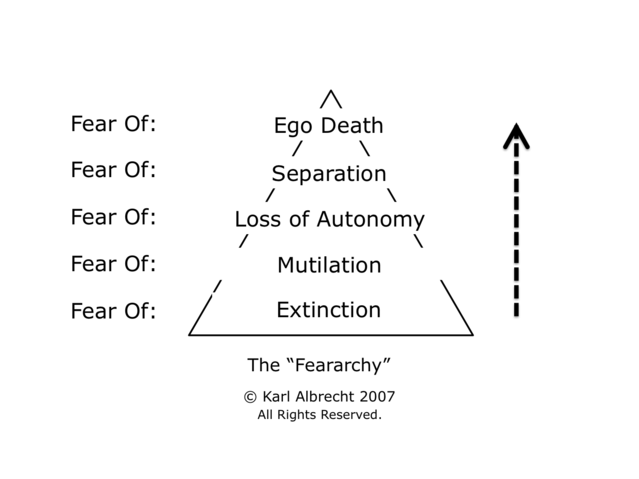
Source: Copyright owned by Karl Albrecht
Recall about the various common labels we put on our fears. Start with the piece of cake ones: fright of heights or falling is basically the fear of extinction (possibly accompanied by meaning mutilation, but that'south sort of secondary). Fear of failure? Read it as fear of ego-decease. Fear of rejection? That'south fright of separation, and probably also fear of ego-death. The terror many people have at the idea of having to speak in public is basically fear of ego-death. Fearfulness of intimacy, or "fear of commitment," is basically fear of losing one'southward autonomy.
Some other emotions nosotros know by various pop names are just aliases for these master fears. If yous rails them down to their nigh basic levels, the bones fears testify through. Jealousy, for example, is an expression of the fear of separation, or devaluation: "She'll value him more than she values me." At its farthermost, information technology tin limited the fear of ego-death: "I'll be a worthless person." Envy works the same way.
Shame and guilt express the fear of—or the bodily condition of—separation and fifty-fifty ego-death. The same is true for embarrassment and humiliation.
Fearfulness is often the base emotion on which anger floats. Oppressed people rage confronting their oppressors because they fear—or actually experience—loss of autonomy and even ego-death. The destruction of a culture or a faith by an invading occupier may exist experienced as a kind of collective ego-decease. Those who make united states of america fearful volition besides make us angry.
Religious bigotry and intolerance may limited the fright of ego-death on a cosmic level, and can fifty-fifty extend to existential feet: "If my god isn't the right god, or the best god, then I'll be stuck without a god. Without god on my side, I'll exist at the mercy of the impersonal forces of the environment. My ticket could be canceled at whatsoever moment, without a reason."
- What Is Fear?
- Find a therapist to combat fear and anxiety
Some of our fears, of course, take basic survival value. Others, nonetheless, are learned reflexes that tin exist weakened or re-learned.
That strange idea of "fearing our fears" becomes less strange when we realize that many of our avoidance reactions—turning downwards an invitation to a party if we tend to be uncomfortable in groups; putting off a doctor's appointment; or not asking for a heighten—are instant reflexes that are reactions to the memories of fright. They happen and so quickly that nosotros don't actually experience the total outcome of the fear. We experience a "micro-fear"—a reaction that's a kind of autograph code for the real fear. This reflex reaction has the same effect of causing us to evade and avoid as the real fear. This is why it's fairly authentic to say that many of our then-chosen fear reactions are actually the fears of fears.
When nosotros let get of our notion of fright as the welling upward of evil forces within u.s.a.—the Freudian motif—and begin to come across fear and its companion emotions as information, nosotros tin think near them consciously. And the more clearly and calmly we can articulate the origins of the fear, the less our fears will affright u.s. and control us.
References
Albrecht, Karl. "Practical Intelligence: the Fine art and Science of Common Sense." New York: Wiley, 2007.
Source: https://www.psychologytoday.com/us/blog/brainsnacks/201203/the-only-5-fears-we-all-share

Post a Comment for "What Are Values People With Funny Fears"